
It’s easy to say that Universal Design is a good architectural goal philosophically…. But what are the PRACTICAL considerations of making spaces accessible to people of all shapes, sizes, and limitations?
Danger, Will Robinson
 |
| "What happens to wheelchair people when they go down steep ramps." I suppose the sign is supposed to be a warning that the ramp is too steep to be a wheelchair accessible one. Image courtesy of operation_janet via Flickr. |
The most common dangers include** but are not limited to:
- Getting in and out of the house
- Using the kitchen
- Using the bathroom
- Using the stairs
Entryways
Steps and Stairs
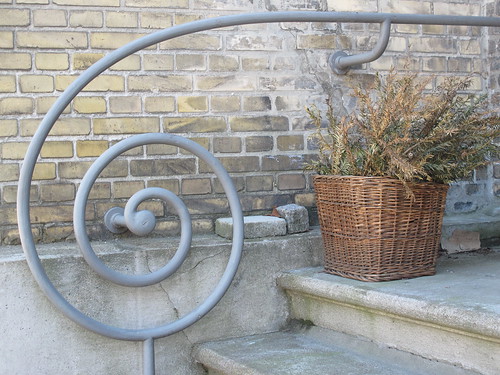 |
| "Swirl." Handrails do not have to be ugly. Image courtesy of Risager via Flickr. |
For stairs, standard building code* allows a maximum 7” rise for every 11” minimum tread. That means to go from a ground level of 0” to a floor level of 35”, you would need five steps, each 11”. 5x11”= 55” (four feet and seven inches).
Don't be too anxious, though, to build steps as steeply as code will allow. Steps that have a more gradual slope (closer to 30 degrees) are much more comfortable to use.
*The residential code allows a slightly steeper stair (7.75"max rise & 10" min tread), but this is not recommended when you're talking about accessibility. In our example, you'd save five whole inches.
Please note: check with your municipality to see which building codes govern you.
 |
| While a pitch/slope of 77% (7.75/10) is allowed, 30 degrees is considered ideal. Image courtesy of Jaksmata via Wikimedia Commons |
If you have a wheelchair to accommodate…. whew. Ramps are a necessity for most homes to be wheelchair accessible, but they can be so unsightly!
Ramps
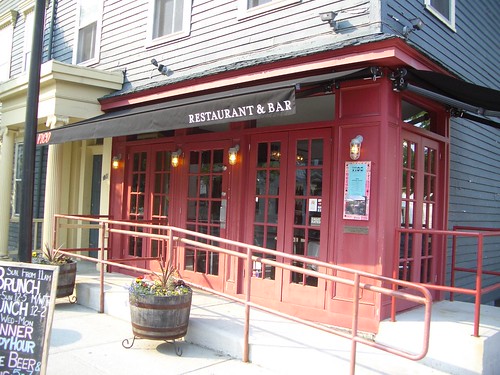 |
| A very nice ramp at the front of a restaurant & bar. Looks like ~12" rise & 15' run with a flat landing at the top. Image courtesy of urbandesigner via Flickr. |
Ramps are often so long that they alter the appearance of a building significantly. Almost no one constructs them unless they absolutely have to.
Ramp options
One way to help limit the area required for a ramp is to adjust landscaping paths from the vehicle parking area to the entry area. Slopes of up to 5% are allowed (and cross-slopes of 2%) on paths without any handrail requirement, and are fairly easy to navigate. If your path is longer than 30 feet, consider including flat rest areas (at least 5 feet long) as part of the path or off to the side.Note: if your ramp edge is 6" or more above the adjacent ground, you'll need a handrail to keep folk on the path. SO make sure your ground level changes with your path.
To make the best use of space, most successful ramps are installed in place of hallways or along one wall, and have short runs with rest areas in between.
Check out this fully accessible, barrier-free Ramp House in Portobello, Edinburgh. Very nice! You can even visit for $206/night.
Bathrooms
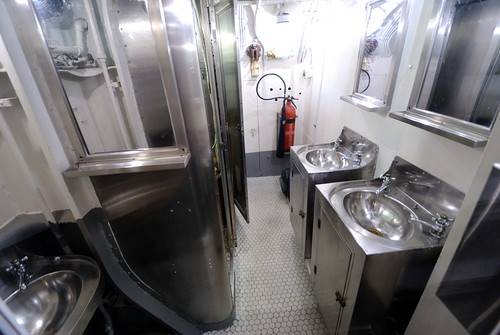 |
| The bathroom is one of the MOST DANGEROUS ROOMS, even if it's not on a submarine. "USS Bowfin - Bathroom" Image courtesy of jdnx via Flickr. |
- Non-slip floor surfaces with ample space to turn around a wheelchair (60” diameter)
- Grab bars which are anchored into the wall (requires reinforced walls) near plumbing fixtures
- Hand-held shower extensions and shower seats
- Barrier-free thresholds at entries and showers (<2” height change at the floor)
- Wide doorways (32” minimum clear width) and lever-handled door hardware
- Higher electrical outlets & lower light switches
- Generous and higher (17” off the floor) bathtub edges that provide a seat for the user to transfer easily from chair to tub.
- Easy access soaking tub for aches/pains and arthritis (hydrotherapy)
Kitchens
Imagine reaching up to an eye-level stovetop to remove some boiling water with pasta in it. Place it on an eye-level countertop and slide it over to the eye-level sink, where a colander is placed 10" below the sink edge on the bottom of the sink. Be sure not to spill: it's hot!Some departures from standard design to consider:
 |
| "Kitchen sink with inset to allow wheelchair access" Image courtesy of homesower via Flickr. |
- table height countertops at certain locations (30" from the floor instead of 36")
- eliminating cabinets under some countertops, cooktops, and sinks (so that a wheelchair can be used and legs slide under): always insulate or cover exposed pipes
- fully extending drawers and shelves on bottom cabinets so the user doesn't have to get on hands and knees to reach the back of the cabinet
- refrigerator drawers, ice drawers, dishwasher drawers, warming drawers
- shallow sink (perhaps as a secondary sink), less than 6" deep
- side-by-side refrigerator and freezer rather than top & bottom design
- task lighting, lower switches, and accessible outlets
- stovetop controls at the front; oven controls and readout not higher than 48"
Not a perfect Universe
Not all in the Universal Design universe is hunky dory, though. My three biggest issues with it:#1 “If you have the space...” and the dough
 |
| diswasher drawers $2400 |
Now to be fair, if new homes were designed using Universal Design principles, they would be more sustainable because they would be able to
- last longer without renovation,
- for a wider variety of inhabitants, and
- would have quite an edge on the market.
AND, while renovation for these types of changes is not cheap, it can be much cheaper than moving into an assisted living facility.

#2 Making Life Easier for Us All
The other issue I have with Universal Design is that one of its main goals is to make living “easier” for everyone. I don’t think that’s a great idea in the modern world. Some days the only exercise I get is bending over for the dishwasher and going up and down the stairs. Didn’t anyone see Wally?Not all of us will benefit from greater physical “ease.”
#3 Not really Universal
 |
| "Lavinia Warren" image courtesy of Mathew Brady via Wikimedia Commons |
Additional reading:
Great resource for Universal Design on hikes and trails by the Federal Highway Administration.Age happy!
-ally
Update 2/21/14 (great article):
An Amazing Village Designed Just For People With Dementia




No comments:
Post a Comment