
There’s one name, though, that keeps popping up so often that even I can't forget it.
Early Childhood Learning
The first time I noticed Rudolf Steiner’s name was in reference to a local Waldorf preschool that I was considering for my children. I didn’t know much about Waldorf*, other than that it reminded me of the Montessori approach: very hands-on and practical skills based.
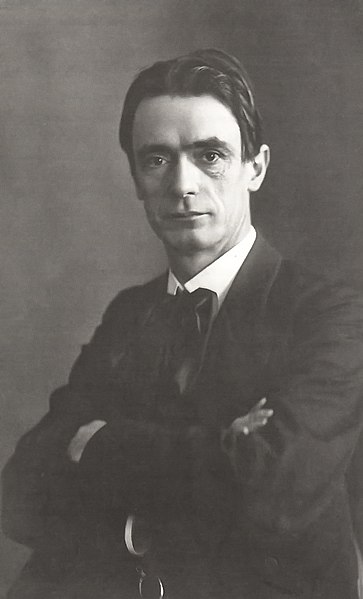 |
| Ruldolf Steiner circa 1905 Image courtesy of Wikimedia. Looks like Jeremy Irons. |
A little research yielded a Waldorf sample schedule for Kindergarten aged children:
8:00 household chores
8:30 morning walk
10:00 snack time, classroom time & story
10:45 creative play or project based on the story
12:00 lunch preparation and lunch
1:00 rest time
2:00 outdoor or indoor play
3:30 craft activity or painting
4:30 read aloud followed by supper preparation
Forget preschool, this is a great schedule for meeeeee!
Steiner believed that learning in early childhood is largely experiential, imitative and sensory-based.
*Note: the name Waldorf comes from the company in Stuttgart for whom Steiner’s first school was built.
Emphasis seemed to be placed on
• experiencing fewer things more deeply (or for longer)
• keeping focused learning in the morning
• allowing a flexible schedule
• involving children in chores
• using snack time to teach food preparation and thanksgiving
• storytelling (not just reading), singing, poetry, music
Most of Steiner's philosophy about education was outlined in "Education of the Child in the Light of Anthroposophy" way back in 1909.
In the Light of Anthropowho?
The next time I ran across Steiner was in an old copy of the Journal of Healthcare Design (Volume VIII). You know, a periodical that architecture geeks read when they want to design a hospital…
 |
| Waldorf School, China Image courtesy of ☼ うみ 目覚めたら via Flickr. |
Vidarkliniken. The article is the result of seven years of research on the architecture of Erik Asmussen in Järna, Sweden, completed in 1988.
 |
| Waldorf School, Santa Fe Image courtesy of BDUngard via Flickr. |
What kind of a building can you do that in?
(exterior pictures here.... and though I could do without all the Miami Beach pink, I am intrigued by the principles.)
First of all, every room has a a view. There are no straight cell walls, but gently curving and embracing shapes. Color and texture are apparent on every wall and daylight moves slowly across the interior spaces touching each surface.
I first read about the Vidarkliniken (Vidar Clinic) while in hospital. As a patient, I was completely disoriented. I’d been brought into the room unconscious; and, though there was a window, its placement meant that I could not see out. The air was stale and chemical and the fluorescent lights buzzed and flickered. There was constant noise, even in the middle of the night and the nurses seemed to think it was more important to comfort themselves by waking me up to check my vitals than to let me sleep. I wanted to be in Järna for recovery, if not for orthopedics.
Healing Architecture
I'm intrigued with a concept of architecture that can be healing. Hospitals, long- and short-term rehab facilities, birth centers, assisted living facilities, spas, retreats... these all need to be healing to the body and uplifting to the spirit.The home should also be a place of healing; some would say even a sacred place.
But Isn’t Steiner Dead?
Yes, he died in 1925, but he was also a spiritualist…. The kind that liked to commune with the dead. Maybe he picked up some tricks. It's pretty easy to make fun of someone whose science isn't very sciency. But there is also genius there, and he fascinates me.
 |
| "Ghost" Image courtesy of The Daring Librarian via Flickr |
 , as an expert on Goethe & Nietzsche and as an early target of Hitler. He practically invented modern organic farming.
I’m just waiting for him to friend me on Facebook. Is he crazy or crazy-like-a-fox? I need to know whether I should run or invite him over for dinner.
--ally



No comments:
Post a Comment